The pattern is familiar enough that it barely needs describing. You need a website. You ask around, someone recommends a freelancer, you have a call that goes well, you transfer the deposit, and then the silences start. 2 weeks becomes 6. The first draft looks nothing like what you discussed. You ask for changes and get told that counts as a new scope. 6 months later you have a website you do not fully own, hosted somewhere you do not have the password for, built on a platform that requires the freelancer to touch every time something needs updating. I heard this story so many times it has become background noise. The advice is always the same: find a better freelancer. That advice is not helpful.
The real problem is not the price
Price is what owners complain about first. It is not actually the deepest problem. A website that costs 1,000 euros and arrives on time, works, and can be updated without calling anyone — that is a good deal. The problem is that the price rarely comes with any of those guarantees. There is no obvious reason for the difference and no way to evaluate quality in advance. So owners either go cheap and get burned, or go expensive and get burned more slowly.
What makes the situation worse is the dependency it creates. A freelancer who holds your hosting credentials and built your site on a custom setup is not a service provider — they are a structural risk. When they go quiet, you cannot easily move. The change feels complex, the downtime feels scary, and you stay. This is not paranoia. It is how many web projects actually end: not with a great website, but with an acceptable one that nobody can touch.
The maintenance problem is its own chapter. A site built in 2022 and never updated since is not a stable asset — it is a decaying one. Links are broken. Address is wrong. Until Google stops ranking it, or a potential client bounces off a page that looks five years old.
How to build and publish it yourself — in one afternoon
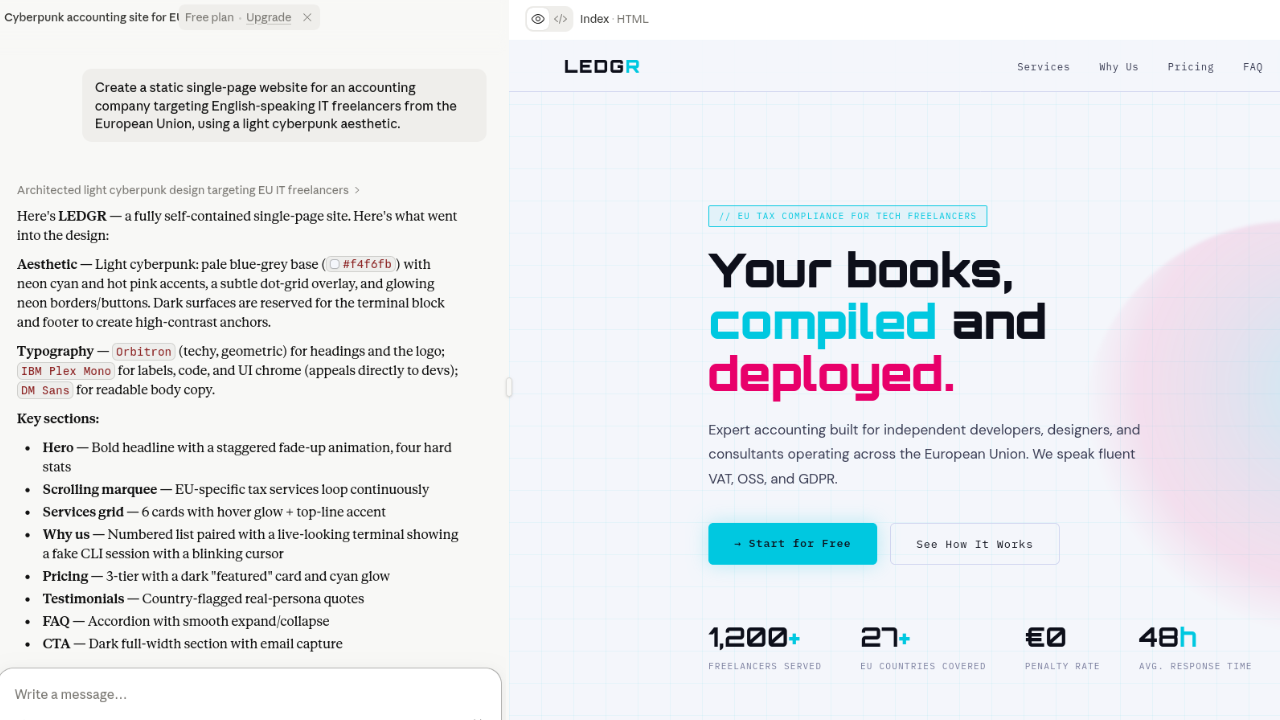
Open a free account on Claude.ai. The free plan is sufficient for this. In the chat, type a single sentence describing what you need — something like: "Create a static single-page website for an accounting company targeting English-speaking IT freelancers from the European Union, using a light cyberpunk aesthetic." Be as specific as you like about your industry, your clients, and the look you want. Then wait about 5 minutes.
The result appears in the panel on the right: a complete, styled website. Not a design, not a draft — a working page you can scroll through and read. If something is wrong, say so in the same chat and ask for a change. When you are happy with it, click Copy, then Download as .html. What you now have on your computer is a single file called index.html. Open it in the browser. It works, with no internet connection, no server, no installation. That is the entire website. You own it completely.
Getting it live takes 60 minutes
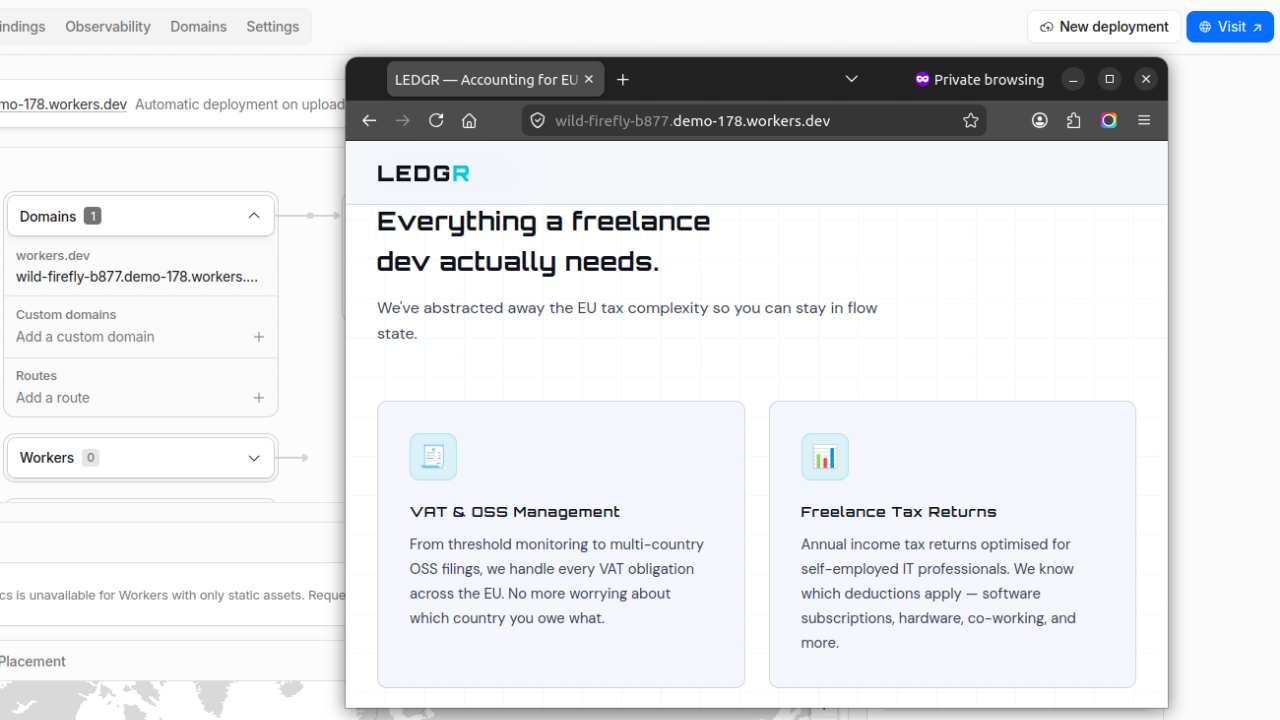
Now create a free account on Cloudflare.com. Go to Domains, then Registrations, and search for the domain name you want — yourcompanyname.com or whatever fits. Register it there. Then go to Build, then Compute, then Workers & Pages. Click Create application, then Upload the index.html file you downloaded. Click Deploy. Then click Add your custom domain, pick the domain you just registered from the list, and confirm. Click Visit.
That is it. Your website is live, on your domain, served from infrastructure that handles one 100,000 page requests per day at no cost. There is no IT infrastructure you are responsible for. The domain is in your hands.
The performance difference between this and a typical freelancer-built WordPress site is not subtle. A static single page served from a Cloudflare global content delivery network loads in under a second from almost anywhere. A WordPress installation on shared hosting, with a theme and 12 plugins, routinely takes 3 to 5 seconds. Most your potential clients leave before the page finishes loading if it crosses 5 seconds. That is not a technical metric — it is lost revenue, from the first day the site is live.
Updating it next month takes 30 minutes
This is the part that changes everything about the relationship with your website. Go back to the same chat on Claude.ai. Ask for whatever needs changing — a new phone number, a different service listed, a price update, a new section. Download the updated index.html file. Go back to Cloudflare Workers & Pages, open your project, and upload the new version. Done.
When updating requires hiring someone, updates do not happen. A phone number changes and the old one stays on the site for a year. A new service gets added to the business and nobody puts it on the website because the friction is too high. When the friction disappears, the site stays current — because current is easy. No email to a freelancer. No invoice. No explanation of what you meant. No waiting to see if they got it right.
What this is for — and what it is not
This method produces a static single-page website. It is the right tool for a business that needs to exist online, be findable, communicate clearly what it does, and give people a way to get in touch — an accounting consultancy, a physiotherapy practice, a law firm. It is not the right tool for a booking system, an online shop, a members area, or anything that requires a database and logic. If you need those things, you need a more involved setup — and the people selling you that setup for 300 euros are probably not going to deliver it reliably.
This is not a permanent solution for a business with big digital plans. It is a solid first step for a business that needs to start without the standard failures: the missing freelancer, the inaccessible hosting account, the slow site nobody can fix, and the invoice for work that was never finished.